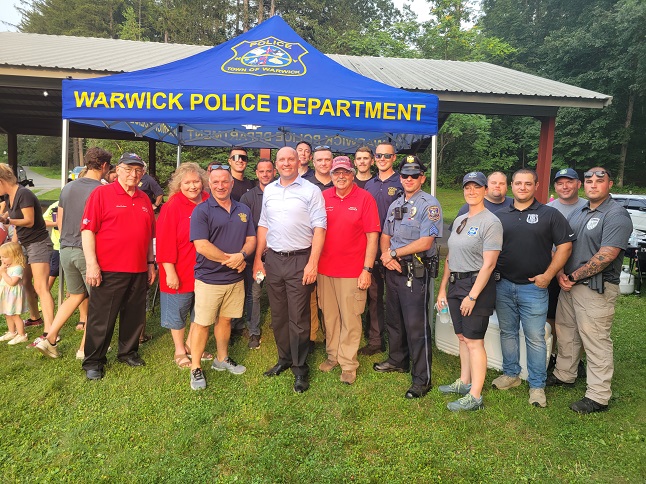


Photo credit: Peter Lyons Hall
By Peter Lyons Hall
On a Saturday morning at Lakeside Farmers Market, the scene looks like what you’d expect from any small-town market: tables of just-picked tomatoes, bunches of basil, jars of local honey. But look closer at the transactions happening at the manager’s table, and you’ll see something more significant than a simple farm-to-table exchange. You’ll see a safety net at work.
Across the country, the food available to families with the tightest budgets is too often the food least likely to keep them healthy — heavily processed, shelf-stable products that dominate supermarket aisles and, with troubling regularity, end up at the center of recalls for contamination or mislabeling. Fresh, local produce is the alternative nutritionists recommend, but it’s also often the first thing to get squeezed out of a tight grocery budget. Lakeside Farmers Market is working to close that gap, using a stack of state and local programs that put real money — and real vegetables — into the hands of the people who need them most.
SNAP Dollars, Stretched Further
Supplemental Nutrition Assistance Program benefits are usually swiped at a supermarket register, but Lakeside Farmers Market has its own setup for it. Shoppers bring their EBT card to the market manager, who runs it and hands back wooden tokens that function as cash at every vendor’s stand. Those tokens can be spent on virtually any food item at the market — produce, meat, dairy, baked goods — with the same restrictions that apply anywhere else SNAP is accepted: no hot or prepared foods, no non-food items, no alcohol.
It’s a small piece of infrastructure — a token exchange at a folding table — but it removes a real barrier. Families who already qualify for federal nutrition assistance don’t have to choose between using their benefits and buying local; at Lakeside, they can do both.
The stakes behind that choice are well documented. Research summarized by anti-hunger group Bread for the World found that when families participating in federal nutrition programs use their benefits at farmers markets, it’s associated with increased fruit and vegetable consumption, a pattern researchers have observed among WIC recipients as well. Nationally, in FY 2023 nearly 7,000 farmers markets and farmers who could accept SNAP generated $71 million in food and produce sales through 2.7 million SNAP EBT transactions — proof that this kind of program isn’t a niche curiosity, but a meaningful piece of how low-income families access fresh food.
Coupons for Seniors: The Farmers’ Market Nutrition Program
A second layer of support comes from New York State’s Farmers’ Market Nutrition Program (FMNP). The state describes its purpose plainly: to promote local farmers by expanding their sales at farmers’ markets, while fostering healthier communities through the consumption of locally grown fruits and vegetables.
At Lakeside, this shows up as coupons, not cards. Each year, the state mails eligible seniors a booklet of five $5 coupons — $25 total — that can be spent exclusively on fresh, unprocessed produce at participating markets. The market itself doesn’t distribute these; they arrive directly from the state to enrolled seniors through their county Office for the Aging. Two of Lakeside’s vendors, J&A and Locust Grove, accept them.
It’s a modest sum on paper, but its purpose is specific: locally grown produce, full stop. No processed snacks, no substitutions — just fruits and vegetables from farmers a few miles down the road.
Market Bucks: A Homegrown Answer to a Local Need
While SNAP and FMNP are state and federal programs, Market Bucks is Lakeside’s own creation — and arguably the piece of this system built most directly around the community’s specific needs. These $5 vouchers are distributed not at the market itself, but through four local touchpoints: the Greenwood Lake Food Pantry, the Greenwood Lake Senior Center, the Arthur Finnegan American Legion Post 1443, and the Warwick VFW Post 4662. That distribution list matters — it means the vouchers reach seniors, veterans, and families already connected to organizations built to catch people who are struggling.
The results have added up. Since the program launched in 2023, more than $17,000 in Market Bucks has been distributed and spent at the market, funded by a mix of community donations and a grant from the New York State Department of Agriculture and Markets. This season alone, shoppers have redeemed more than $2,500 worth so far — money that flows directly to the market’s vendors, supporting the same small farms the program is designed to sustain.
But Market Bucks runs on donations, and the market is now looking for additional support to finish the season strong. More funding means more vouchers in the hands of more veterans, seniors, and neighbors facing food insecurity — and more revenue for the local growers who depend on market season to make ends meet.
Why It Matters
Take these three programs together, and Lakeside Farmers Market isn’t just a weekend attraction — it’s functioning as genuine anti-hunger infrastructure, tailored to Greenwood Lake. SNAP tokens meet people where their existing benefits are. FMNP coupons put a state mandate for senior nutrition directly into practice. And Market Bucks fills in the gaps state and federal programs don’t reach, built and funded by the community itself.
In a food system where the cheapest, most accessible calories are often the least nutritious — and where recalls of mass-produced food remind us how much can go wrong at scale — a market like Lakeside offers something simpler and more trustworthy: food grown a few miles away, sold by the people who grew it, made affordable for the people who need it most.
Anyone interested in supporting the Market Bucks program can contribute to help ensure Lakeside Farmers Market can keep expanding access through the rest of this season and beyond.