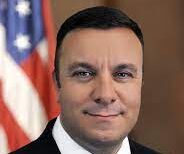


NEWBURGH — Congressman Pat Ryan joined local officials, environmental advocates and community members in Newburgh last week to protest a newly extended federal timeline for addressing PFAS contamination associated with Stewart Air National Guard Base.
According to Ryan’s office, the Department of Defense’s Remedial Investigation and Feasibility Study, a key step toward selecting a permanent cleanup plan, had been expected to be completed in September 2026. The timeline has now reportedly been pushed back to 2051 — a delay of approximately 25 years.
PFAS, or per- and polyfluoroalkyl substances, are a group of persistent chemicals commonly referred to as “forever chemicals.” At Stewart, contamination associated with firefighting foam has affected the watershed feeding Washington Lake, historically the City of Newburgh’s primary drinking-water source. Newburgh has since relied on alternative water supplies.
Ryan, a member of the House Armed Services Committee, said he raised concerns with Defense Secretary Pete Hegseth after earlier delays were reported, requesting that the Department restore existing remediation timelines and provide a detailed explanation. Ryan’s office said no response was received before reports emerged of additional delays.
“Every American — especially our kids — deserves to have clean drinking water,” Ryan said. “The federal government should be speeding up the clean-up, not slowing it down by decades.” He characterized the latest delay as a “massive betrayal.”
Local environmental groups echoed those concerns.
“It is unacceptable that the Department of Defense is delaying this cleanup for an unprecedented 20-plus years while the people of Newburgh and New Windsor have to live with the consequences,” said Dan Shapley, senior director of advocacy, policy and planning for Riverkeeper. Shapley pointed to interim projects underway this year as evidence that progress can be made without waiting decades.
David H. Toman of Hudson River Sloop Clearwater also urged the Defense Department to move ahead with the investigation and feasibility study, saying, “Clean drinking water and the health of our community should not, and cannot, wait decades for action.”
The issue carries financial implications for Newburgh as well. Councilman Ronald Zorrilla said New York State is currently paying for the city’s alternative water supply and warned that residents could face substantial rate increases if that support were to end.
“Buying us water is not a cleanup,” Zorrilla said. “The Defense Department doesn’t get to rent its way out of this until 2051.”
The 2051 date applies to the federal remedial investigation and feasibility-study schedule and does not mean that all PFAS-related work at Stewart has been suspended until then. Interim remediation projects and other measures can continue.
Ryan and participating environmental groups are calling on the Defense Department to explain the extended timetable and accelerate work toward a permanent solution for the Stewart contamination.